How to make the most of seductive Siem Reap, Cambodia

After many years of being considered just one-third of a gap year traveller's Silk Road trifecta, Cambodia is now coming into its own.
Not only is this evidenced in two new airports in its main arrival hubs, Phnom Penh and Siem Reap, but also in a flurry of upmarket hotel openings, with spas and poolside cocktails now almost as ubiquitous as backpacker hostels (and, to be honest, not even outrageously more expensive).
While Phnom Penh* has modernised at a rapid pace and attracts large numbers of expats, Siem Reap's star quality is inextricably bound up with its proximity to ancient temple complexes.
Even so, Cambodia's 'second city' offers far more than just a day trip to Angkor Wat. Yes, affordability is a factor: you can eat incredibly well, wash everything down with a couple of beers and finish up with an hour-long foot massage, and probably still have change from £15. There are also plenty of attractions in and around Siem Reap.
Getting there: book expert-led, small group trips to Siem Reap with Intrepid Travel*, which specialises in responsible, community-led experiences.
Visit Angkor Wat
Built in the first half of the 12th century, Angkor Wat is the world's largest religious monument; an undeniably spectacular and unmissable feat of ancient architecture.
Based on historical estimates and clues within the temple inscriptions themselves, its construction was carried out by around 300,000 workers; the stone used was sourced from quarries at the base of nearby Mount Kulen and transported by 6,000 elephants.
Originally a place of Hindu worship, dedicated to Vishnu, the late 12th century saw Angkor Wat become a Buddhist temple, blending elements of the two religions in its iconography when a later ruler converted with the encouragement of his wife.
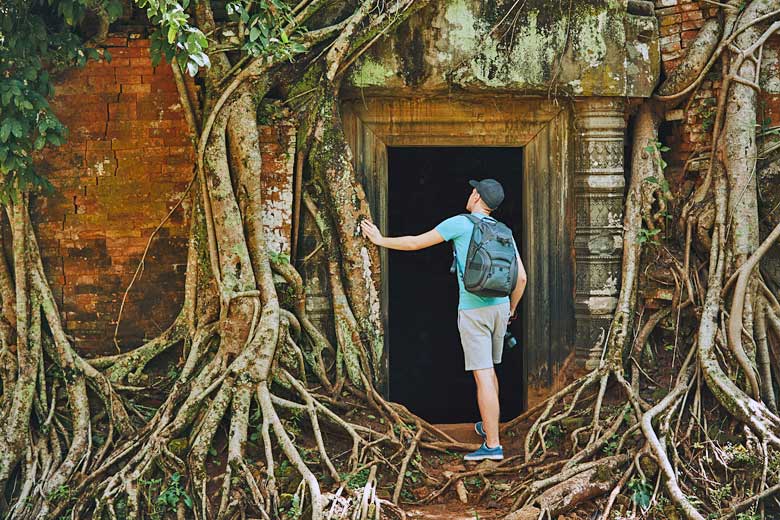
Given this history and significance, it's a shame that so many visitors, arriving before sunrise, seem only intent upon capturing the 'money shot' of the sun rising behind Angkor Wat's temples and illuminating the reflective pools that lie in front of it.
In any case, a glorious sunrise is never guaranteed, so plan, instead, to spend time examining the bas-relief carvings that smother the temple walls, which were painstakingly chiselled by skilled artisans and stonemasons.
Many of the images depict apsaras, or celestial, nymph-like dancers, whose different forms are likely to have been inspired by wives, mothers and sisters; that is, the ideas that the individual craftspeople held of female perfection.
Explore the wider archaeological park
Sprawling over 155 square miles, the vast Angkor Archaeological Park not only contains an array of temples, each magnificent and compelling in its own right, it also offers tantalising glimpses into ancient engineering, with some parts of its ancient hydraulic system visible above ground.
But the temples are, of course, the primary draw. Ta Prohm came to recognition for its star turn in Tomb Raider and is indisputably photogenic, even without Angelina Jolie in the picture. It's a tumble of huge stones bound by meltingly Dali-esque visions of roots and moss.
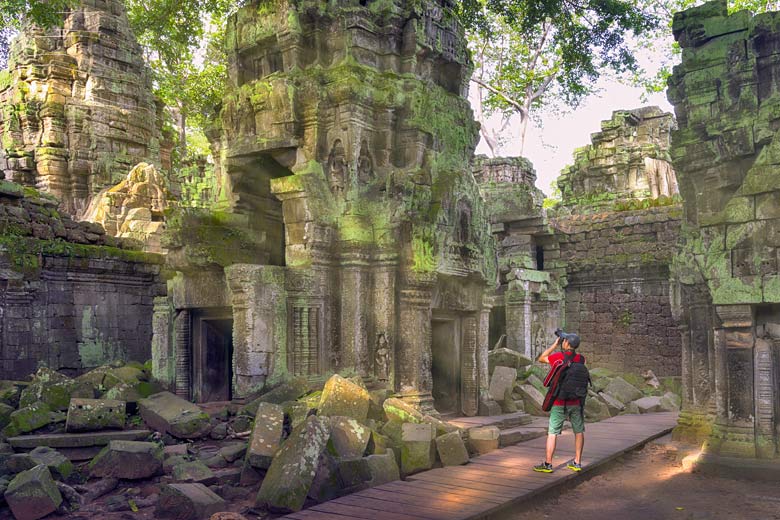
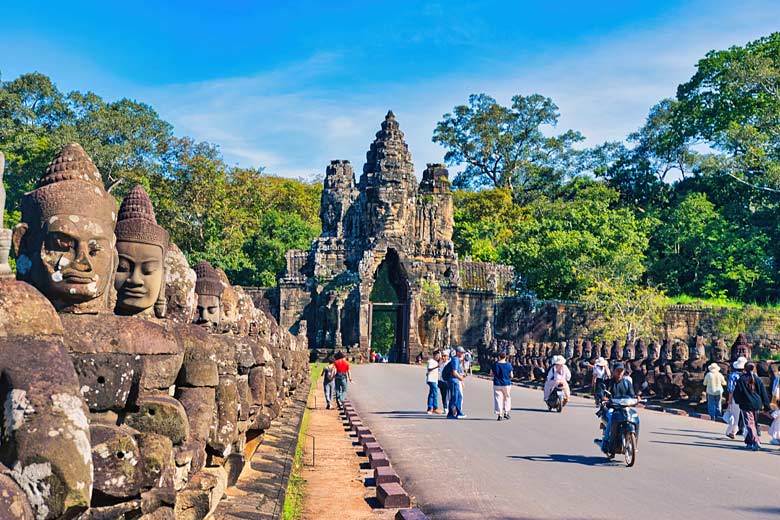
There's also Angkor Thom, set within a moated site, and Bayon Temple, from which beatific stone faces gaze outwards. Located about 25 km north, the small but richly decorated Banteay Srei is notable for its red sandstone construction, which glows pink in the sun.
Soak up history at the national museum
Visiting the Angkor National Museum is an invaluable addition to your temple visits, providing context and an understanding of symbolism and belief systems which help to bring the ancient ruins and the Khmer Empire to life. This might be especially worthwhile if you're planning to explore Angkor without a guide.
Most of the artefacts date from the 9th to 14th centuries, and these are displayed across eight galleries, each with a different theme, such as daily life, costumes and royalty.
It's difficult not to linger in the circular 'Gallery of a Thousand Buddhas', especially once you start reading the signs providing information on what the many poses and hand gestures of the Buddhas mean.
However, avoid disappointment by knowing in advance that many of the Buddhas in this gallery were made in the last century, based on historical references.
The building itself is modern and air-conditioned, a welcome reprieve from the often-oppressive midday heat.
Spend an evening the Cambodian circus
Located in a big top just behind the Angkor National Museum, Phare: The Cambodian Circus opened in 2013, with nightly performances showcasing the skills of local performers, primarily those from vulnerable and disadvantaged backgrounds.
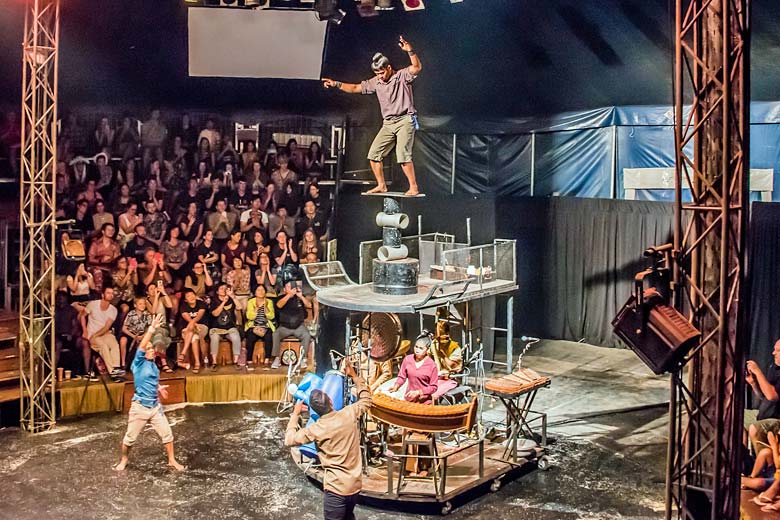
Many of the people involved have found solace from their troubled lives through pursuing these artistic endeavours (contortionism, acrobatics, and dance, for instance), which means that attending a performance means participating in a socially-driven enterprise, as well as experiencing an entertaining evening of high-octane theatre.
It's also an opportunity to learn more about Cambodian folklore and storytelling through the various forms of artistry on show. Stay behind after the main event for a chance to meet some of the talented entertainers involved.
Shop with your eyes at the Old Market
Doubly enticing thanks to the fact that more locals than tourists will be spotted here, the centrally-located Old Market, or Psar Chaa, is crammed with colour and heavy with scent.
Expect high-piled spices to trick you into thinking that you'll never buy another ready-meal when you get home; gleaming silverware winks alluringly, and bolts of fabrics and ready-made textiles murmur "I'll swathe you gorgeously, promise."
In all, it's a seductive atmosphere and, therefore, one in which it's easy to become overwhelmed. Arrive early, when the 'real' shoppers are there, and vendors are otherwise occupied with genuine transactions: this will give you an opportunity to see the market in action without feeling drawn into more-than-passing interactions or pressured purchases.
Need a breather? Grab a fresh coconut juice from one of the stalls on the market's perimeter.
Wind down with a massage
There's a reason why massage treatments from Southeast Asian countries are so popular: a traditional emphasis on holistic practices, combined with the deeply rooted belief that massage should be as restorative and health-giving to the mind and body as it is relaxing.
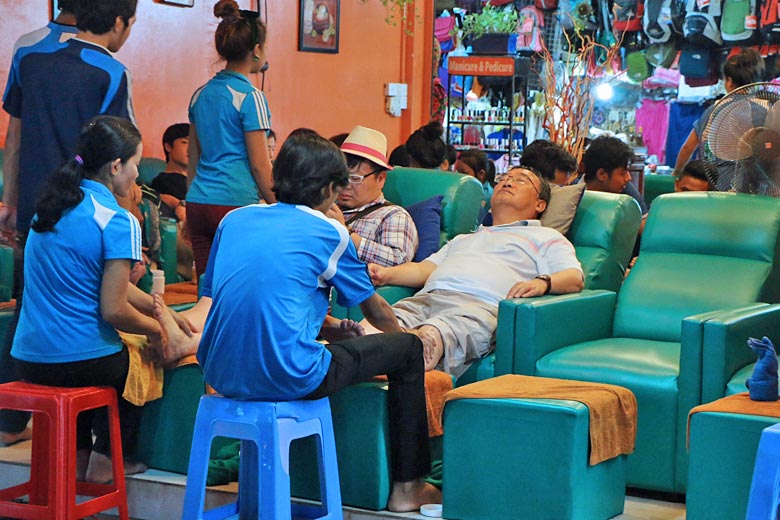
Khmer tradition focuses on circulation and 'flow' (known as 'Qi'), and some establishments use local herbs and potions, which help give the experience an even stronger sense of place.
Additionally, after a day of exploring (in often sticky heat, no less) most travellers are going to want to wind down. The hotel pool, if you have one, is one way to do this; an indulgent spa treatment and massage are quite another. Another bonus? You can expect to pay as little as £5 for an hour of pampering.
Party on Pub Street
Centrally located as it is, you're not likely to be able to avoid Pub Street, even if you have an aversion to boozy tourist hubs.
Once Cambodia* opened to tourists in the 1990s, it wasn't long before a dirt track burgeoned into a neon-lit strip, loud with music, crowded with revellers and flowing with cheap drinks.
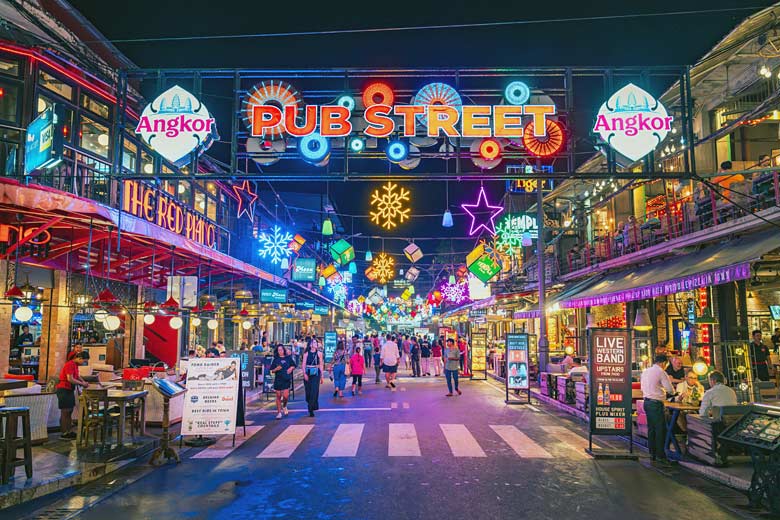
There's also a variety of street foods on offer, from traditional Khmer cuisine to more 'sensational' options, such as fried insects, including tarantulas. You might not fancy chowing down on the latter, but it's likely you'll want to take a photo: be prepared to pay for the privilege.
If the main drag proves to be too much for your senses, duck and dive into one of the side streets, as there are plenty of smaller, quieter establishments in which to wet your whistle.
Take in a traditional dance show
You'll see artistically rendered Apsara dancers all over the walls of the Angkor temple complexes and, as beautiful and elegant as these are, the context provided by seeing a live performance is something that every visitor should take advantage of while in Siem Reap*.
Apsaras, as mentioned, are heavenly nymph-like creatures in Cambodian mythology. Apsaras dancers undertake rigorous training from a young age, learning techniques to narrate ancient stories through complex movements, especially with their hands and fingers, which at times seem to twist into impossibly elaborate formations.
There's a spellbinding, trance-like quality to this form of dance, heightened by slow movement and a mask-like face, with the mere hint of a curve at the lips suggesting a detached tranquillity, all in keeping with the divine element of the art form.
Many hotels in Siem Reap host Apsara performances; otherwise dinner shows can be booked at the Apsara Theatre, which opened in 1997.
Sail Away on Tonlé Sap Lake
As Southeast Asia's largest freshwater lake, Tonlé Sap is something of a spectacle in itself: vast and shimmering, it's easily reached via a short drive from the centre of Siem Reap. Its main draw for visitors, however, is the presence of floating villages that move with the lake's shifting water levels.
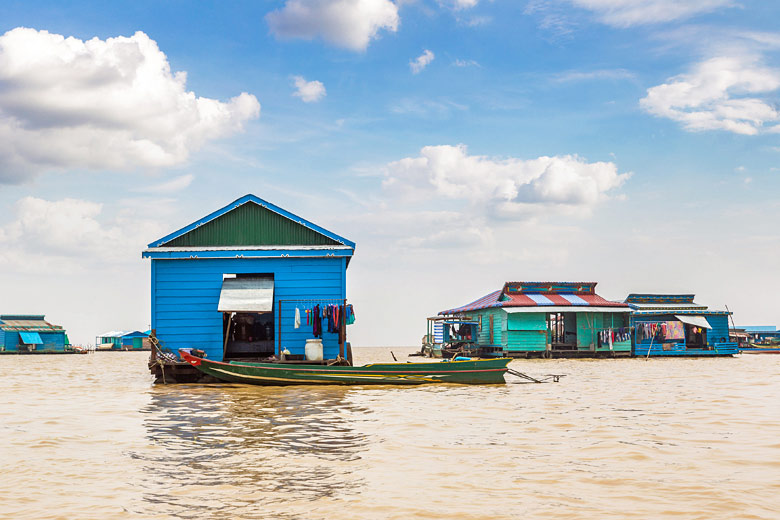
Some properties are little more than platforms under which barrels are lashed for buoyancy; others are built on stilts, ringed by water marks clearly delineating the ebb and climb of the lake from which they rise.
Fishing is, unsurprisingly, the main industry here, but community enterprises also focus on tourism, with groups of women offering kayaking trips through the mangroves or selling snacks and drinks from floating markets.
The communities closest to Siem Reap may not offer the most insightful experience, as they're more heavily touristed than those further out.
Chong Kneas is best avoided on these grounds, while Kampong Phluk and Kampong Khleang are still easily reachable on a day trip and offer more of a genuine glimpse into this unique way of life. Most hotels and local tour operators offer visits to the area; expect to pay around £30 per person.
Climate in Siem Reap
| Jan | Feb | Mar | Apr | May | Jun | Jul | Aug | Sep | Oct | Nov | Dec | |
|---|---|---|---|---|---|---|---|---|---|---|---|---|
| Maximum daytime temperature °C |  31 31 |
34 |
36 |
36 |
34 |
33 |
32 |
32 |
31 |
31 |
31 |
30 |
| Hours of sunshine (daily) | ||||||||||||
| Days with some rainfall |  1 1 |
2 |
 4 4 |
 7 7 |
 15 15 |
15 |
 18 18 |
18 |
18 |
15 |
6 |
2 |





The above guide shows the climate in Siem Reap. Find out more about conditions across the country in our complete guide to the climate in Cambodia.
Ready to explore Siem Reap? Check out the latest offers on trips with Intrepid Travel.
More about Siem Reap





Siem Reap by month
Jan Feb Mar Apr May Jun Jul Aug Sep Oct Nov Dec
Explore holiday destinations
- Beach holidays
- City breaks
- Family holidays
- Half term holidays
- Spring holidays
- Summer holidays
- Autumn holidays
- Winter sun holidays
- Honeymoons
- Coolcations
- Compare places
- Ski resorts
Save with latest deals & discounts
- Holiday offers
- Top travel brands
- Airlines & flights
- Discount hotels
- TUI
- Jet2holidays
- Neilson
- Marella Cruises
- Holiday Extras
- Pierre & Vacances
- Caledonian Travel
- Club Med
Airport parking
- Manchester Airport
- Stansted Airport
- Bristol Airport
- Luton Airport
- Birmingham Airport
- Edinburgh Airport
- Gatwick Airport
- Glasgow Airport
- Newcastle Airport
Airport lounges
- Manchester Airport
- Birmingham Airport
- Bristol Airport
- Edinburgh Airport
- Glasgow Airport
- Heathrow Airport
- Newcastle Airport
- Stansted Airport
- Gatwick Airport
Be inspired
Get your weekly fix of holiday inspiration from some of the world's best travel writers plus save on your next trip with the latest exclusive offers
We promise not to share your details