





























- Save up to 25% on hotel stays when you book advance
- Radisson Rewards members get extra 10% off hotels
- Book hotels in Europe, Middle East, Africa, Asia & Pacific
Colorado weather by month
Check out Colorado weather averages by month. Compare detailed monthly climate statistics including temperature, rainfall and sunshine figures.
| Jan | Feb | Mar | Apr | May | Jun | Jul | Aug | Sep | Oct | Nov | Dec | |
|---|---|---|---|---|---|---|---|---|---|---|---|---|
| Maximum daytime temperature °C | ||||||||||||
| Hours of sunshine (daily) | ||||||||||||
| Days with some rainfall |
More about Colorado
Colorado by month
Jan Feb Mar Apr May Jun Jul Aug Sep Oct Nov Dec
Recommended for Colorado

The climate guide for Colorado (Denver) shows long term monthly weather averages processed from data supplied by CRU (University of East Anglia), the Met Office & the Netherlands Meteorological Institute. Find out more about our data sources.
Top Colorado destinations
Below are average maximum temperatures at popular destinations in Colorado for next month - May. Select a destination to see the climate guide for all months of the year.
All Colorado destinations
- Alamosa
- Aspen
- Breckenridge
- Colorado Springs
- Denver
- Durango
- Estes Park
- Fort Collins
- Glenwood Springs
- Grand Junction
- Pueblo
- Telluride
- Vail
Metric (°C / mm) | Imperial (°F / inches)
Colorado climate overview
The state of Colorado straddles the highest regions of the Rocky Mountains between Utah in the west and Kansas in the east. Colorado is famous for the rarefied air of its forested snow-covered mountains and has the highest average elevation of any state. It is also a land of great contrasts. In the west there is desert and in the east a vast rolling prairie.
The capital, Denver - 'Mile High City', is situated on the edge of this prairie where the mountains and the plains meet, with about half the state's population living in the surrounding area.
To the west of Denver mountains rise abruptly and extend westwards for over 160 kilometres (100 miles). Among the many ranges there are more than 1,000 peaks over 3,000 metres (10,000 ft), and some of the most famous ski resorts in the world such as Vail and Aspen.
Further west, the mountains give way to the rugged Colorado Plateau with broken tablelands, which over the years have become eroded by melt-waters off the mountains.
Colorado has an extreme climate with summer temperatures ranging from comfortable in the mountains to hot on the plains, and long cold winters almost everywhere.
In winter, mountain temperatures regularly fall below -18°C (0°F) and the eastern plains are occasionally affected by blizzard conditions when polar air masses collide with warmer moist air off the Gulf of Mexico. The plains are also particularly prone to severe thunderstorms in the spring and summer months.
Colorado's distance from the Pacific Ocean and the Gulf of Mexico means that rainfall levels are generally low. In winter precipitation falls almost entirely as snow, especially in the mountains, leading to abundant snow cover. For most of western Colorado rainfall levels are higher in winter than in summer, whereas in the east the opposite is true.
Throughout the state sunshine levels are high. Denver boasts an average of more than 60% of daylight hours with bright sunshine for every month of the year. Clear skies, spectacular scenery and cool mountain temperatures at the height of summer make Colorado a popular destination.
More about the USA
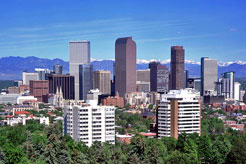


Compare Colorado with the USA
Below the Colorado chart shows average maximum daytime temperature for Colorado, USA (Denver) and the USA (Washington).
Maximum daytime temperature (°C)
Colorado, USA (Denver)
USA (Washington)
Jan
Feb
Mar
Apr
May
Jun
Jul
Aug
Sep
Oct
Nov
Dec
Metric (°C / mm) | Imperial (°F / inches)
Compare more Colorado weather >>
Be inspired
Get your weekly fix of holiday inspiration from some of the world's best travel writers plus save on your next trip with the latest exclusive offers
We promise not to share your details
Related posts



Popular travel offers


Explore holidays in the sun for less
- Beach holidays
- Family holidays
- City breaks
- Summer holidays
- Winter sun holidays
- Holiday offers
- Top travel brands
- Airlines & flights
- Discount hotels
- Airport parking deals
- TUI
- Jet2holidays
- easyJet holidays
- Love Holidays
- British Airways
Airport parking
- Manchester Airport
- Stansted Airport
- Bristol Airport
- Luton Airport
- Birmingham Airport
- Edinburgh Airport
- Gatwick Airport
- Glasgow Airport
- Newcastle Airport
Airport lounges
- Manchester Airport
- Birmingham Airport
- Bristol Airport
- Edinburgh Airport
- Glasgow Airport
- Heathrow Airport
- Newcastle Airport
- Stansted Airport
- Gatwick Airport