






















- Book online with TUI & save up to 7% on holidays
- FREE child places available for select holidays
- Pay £0 deposits with direct debit & spread the cost
Indonesia weather by month
Check out Indonesia weather averages by month. Compare detailed monthly climate statistics including temperature, rainfall and sunshine figures.
| Jan | Feb | Mar | Apr | May | Jun | Jul | Aug | Sep | Oct | Nov | Dec | |
|---|---|---|---|---|---|---|---|---|---|---|---|---|
| Maximum daytime temperature °C | ||||||||||||
| Hours of sunshine (daily) | ||||||||||||
| Days with some rainfall | ||||||||||||
| Sea temperature °C |
More about Indonesia
Indonesia by month
Jan Feb Mar Apr May Jun Jul Aug Sep Oct Nov Dec
Recommended for Indonesia
 TUI deal finder
The climate guide for Indonesia (Jakarta) shows long term monthly weather averages processed from data supplied by CRU (University of East Anglia), the Met Office & the Netherlands Meteorological Institute. Find out more about our data sources.
Top Indonesia destinations
Below are average maximum temperatures at popular destinations in Indonesia for next month - May. Select a destination to see the climate guide for all months of the year.

All Indonesia regions
All Indonesia destinations
- Ambon
- Amed, Bali
- Balikpapan
- Banda Aceh
- Bandar Lampung
- Bandjermasin
- Bandung
- Bengkulu
- Biak
- Bima
- Bintan Island
- Bukittinggi
- Cirebon
- Denpasar, Bali
- Gili Islands, Lombok
- Jakarta
- Jayapura
- Kendari
- Kintamani
- Kupang
- Kuta, Bali
- Kuta, Lombok
- Labuan Bajo
- Makassar
- Malang
- Manado
- Manokwari
- Mataram, Lombok
- Maumere
- Medan
- Merauke
- Nias
- Nusa Dua, Bali
- Padang
- Palembang
- Pangkalanbuun
- Prapat
- Rantepao
- Samarinda
- Sanur, Bali
- Semarang
- Seminyak, Bali
- Senggigi, Lombok
- Singaradja, Bali
- Sorong
- Surabaja
- Tarakan
- Ternate
- Ubud, Bali
- Waingapu
- Yogyakarta
Metric (°C / mm) | Imperial (°F / inches)
Indonesia climate overview
Indonesia is the largest archipelago in the world with over 15,000 islands ranging in size from hundreds of kilometres across to tiny palm fringed atolls. It sits astride the Equator in South East Asia stretching over 5,000 kilometres (3,200 miles) from the Indian Ocean to the Pacific, further than the distance from Los Angeles to New York.
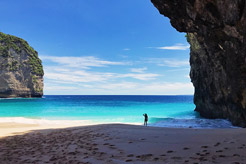
With its rich cultural heritage and diverse population Indonesia offers travellers an enormous variety of destinations and holiday experiences. Apart from spectacular mountain volcanoes, deep tropical rainforest and miles of white sandy beaches there is history, architecture, music, dance and traditional crafts.
Indonesia is the fourth most populated country in the world and over half the 240 million population lives on the relatively small island of Java, making this the most densely populated place on earth.
The vegetation throughout the country is tropical with large areas of rainforest still standing on the islands of Sumatra, Borneo, and New Guinea. Much of the original forest on Java has been cleared for cultivation, mainly for rice, however areas of wilderness can still be found such as at the Ujung Kulon National Park in the west.
Sumatra and Borneo are much wilder than Java although increasing tracts of forest are now being cleared for rubber and palm oil plantations. Western New Guinea on the other hand is very remote and contains some of the most inaccessible places on earth.
A chain of volcanic mountains stretches down the western side of Sumatra, extending to Java and Bali and through the islands of Nusa Tenggara to the east. Within this chain there are about 70 active volcanoes, most of which have erupted at some time in the past 100 years.
Lake Toba in Northern Sumatra was the scene of a mega-volcanic eruption 72,000 years ago which, it is estimated, killed most of the inhabitants of South East Asia, while the eruption of Krakatoa in 1883, though tiny by comparison, is still one of the largest in recorded history.
There are only two types of weather in Indonesia, fine and sunny or cloudy and wet. Temperatures are fairly constant throughout the year and depend mainly on elevation above sea level, while heat and humidity is high in all months. All the islands lie outside the tropical cyclone belt although some in the extreme south, such as Timor and Sumba, are occasionally affected by cyclones.
The wet season arrives in November on the north-west monsoon which blows until March bringing rain from the Indian Ocean to most of the country. Usually during this time the further west and north you are the more rain there is. However there is generally also a fair amount of sunshine during the wet season almost everywhere except in the mountains. In Bali for example, in the south of the island, there will be on average 8 hours of sunshine each day during December, January and February.
Generally drier weather conditions prevail during the south-east monsoon period from June to September especially over the islands nearest to Australia which includes Java and Bali and Lombok.
Daytime temperatures are only a degree or so cooler than during the wet season, but there is noticeably less heat and humidity at night. Unusually the central islands of the Moluccas, with destinations such as Ambon and Banda, experience their wet season during this time.
Indonesia is one of the most active volcanic and seismic areas in the world with earthquakes recorded almost every day and more volcanic eruptions than any other region in the world. The northern part of Sumatra, particularly the Aceh region, was hit hard by the Asian Tsunami of December 2004. Tens of thousands of lives were lost, and damage was extensive.
More about Indonesia

Compare Indonesia with the USA
Below the Indonesia chart shows average maximum daytime temperature for Indonesia (Jakarta) and the USA (Washington).
Maximum daytime temperature (°C)
Indonesia (Jakarta)
USA (Washington)
Jan
Feb
Mar
Apr
May
Jun
Jul
Aug
Sep
Oct
Nov
Dec
Metric (°C / mm) | Imperial (°F / inches)
Compare more Indonesia weather >>
Be inspired
Get your weekly fix of holiday inspiration from some of the world's best travel writers plus save on your next trip with the latest exclusive offers
We promise not to share your details
Related posts
Popular travel offers


Explore holidays in the sun for less
- Beach holidays
- Family holidays
- City breaks
- Summer holidays
- Winter sun holidays
- Holiday offers
- Top travel brands
- Airlines & flights
- Discount hotels
- Airport parking deals
- TUI
- Jet2holidays
- easyJet holidays
- Love Holidays
- British Airways
Airport parking
- Manchester Airport
- Stansted Airport
- Bristol Airport
- Luton Airport
- Birmingham Airport
- Edinburgh Airport
- Gatwick Airport
- Glasgow Airport
- Newcastle Airport
Airport lounges
- Manchester Airport
- Birmingham Airport
- Bristol Airport
- Edinburgh Airport
- Glasgow Airport
- Heathrow Airport
- Newcastle Airport
- Stansted Airport
- Gatwick Airport